

News
Discovering a Black Hole's Unexpected Twist Even Einstein Couldn't Have Predicted
2025-10-01 Research
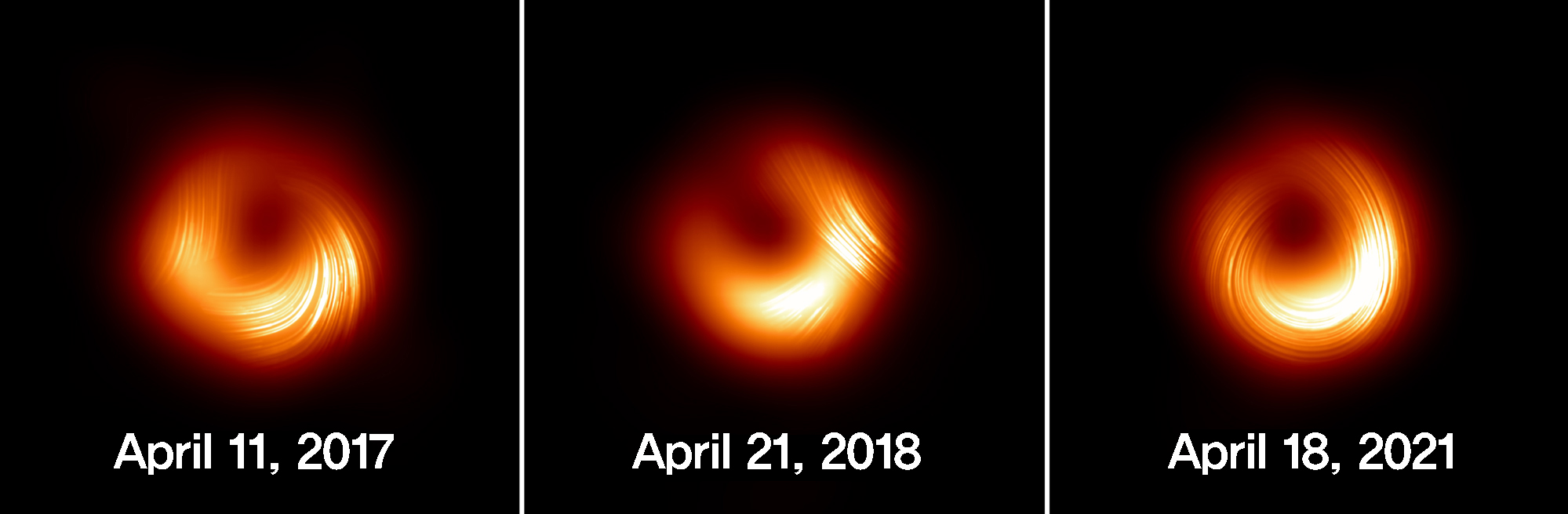
A research team led by Professor Jongho Park of the School of Space Research and the Event Horizon Telescope (EHT)* collaboration has released a new image of the supermassive black hole M87, revealing surprising changes in its polarization structure
This image, derived obtained from observations made in 2021, comes three years after the first black hole observation in human history in 2017 and the follow-up observations made in 2018. By comparing the datasets, the team explored the temporal evolution of the M87, analyzing how the black hole’s appearance changes over time. Their findings revealed that while the central dark region, known as the black hole shadow, and the ring of light bent by the black hole's immense gravity remain constant in size, the polarization pattern around the black hole has dynamically shifted over time.
These changes in polarization around the black hole suggest a temporal rearrangement of the magnetic field structure near the event horizon or a shift in the influence of hot plasma along the line of sight. These results indicate that the environment surrounding the black hole is far more dynamic and complex than previously understood, underscoring the need for continued observation and theoretical research.
Tracking magnetic field changes around the M87 captures unexpected polarization reversal
Professor Park's research team contributed significantly to this observation by developing GPCAL, a polarization correction software that precisely separates and corrects the instrumental polarization generated by telescopes and receivers. This enables researchers to precisely isolate the true polarization signal emitted by the black hole itself. GPCAL was first adopted as a primary analysis tool in the EHT international collaborative analysis, which significantly enhanced the accuracy and reliability of the magnetic field map around black holes.
As co-leader of the M87 polarization imaging team, Professor Park oversaw the long-term data correction and verification process, ensuring the reproducibility and stability of the results. He explained, "The size of the black hole ring has remained consistent over the years, confirming the black hole shadow predicted by Einstein's theory of general relativity. However, the polarization pattern has changed significantly. This result suggests that the magnetized plasma swirling near the event horizon is highly dynamic and complex."
Dr. Paul Tiede of the Harvard & Smithsonian Center for Astrophysics, one of the principal investigators of this international collaboration, said, "Years of black hole imaging deepens our understanding of one of the most extreme environments in the universe." The EHT international research group has been observing M87 since 2017, producing new results. In 2026, they plan to observe M87 twice a week for approximately three months to capture black hole video. This will allow them to capture a more precise, real-time picture of the black hole's evolution. The results of this research are forthcoming in Astronomy & Astrophysics under the title, “Horizon-scale variability of M87* from 2017-2021 EHT observations.”

* The Event Horizon Telescope (EHT) is both an international collaborative project and a global virtual telescope that links radio observatories around the world to form an Earth-sized virtual radio telescope array capable of imaging black holes. The term “event horizon” refers to the boundary separating the interior of a black hole from the observable universe.
-
Info
- University Communication & Press
- +82-2-961-0106
- khsd3080@khu.ac.kr