News
Kyung Hee Nuclear Engineering Students Continue to Win Honors at International Conferences
2025-10-17 Academic
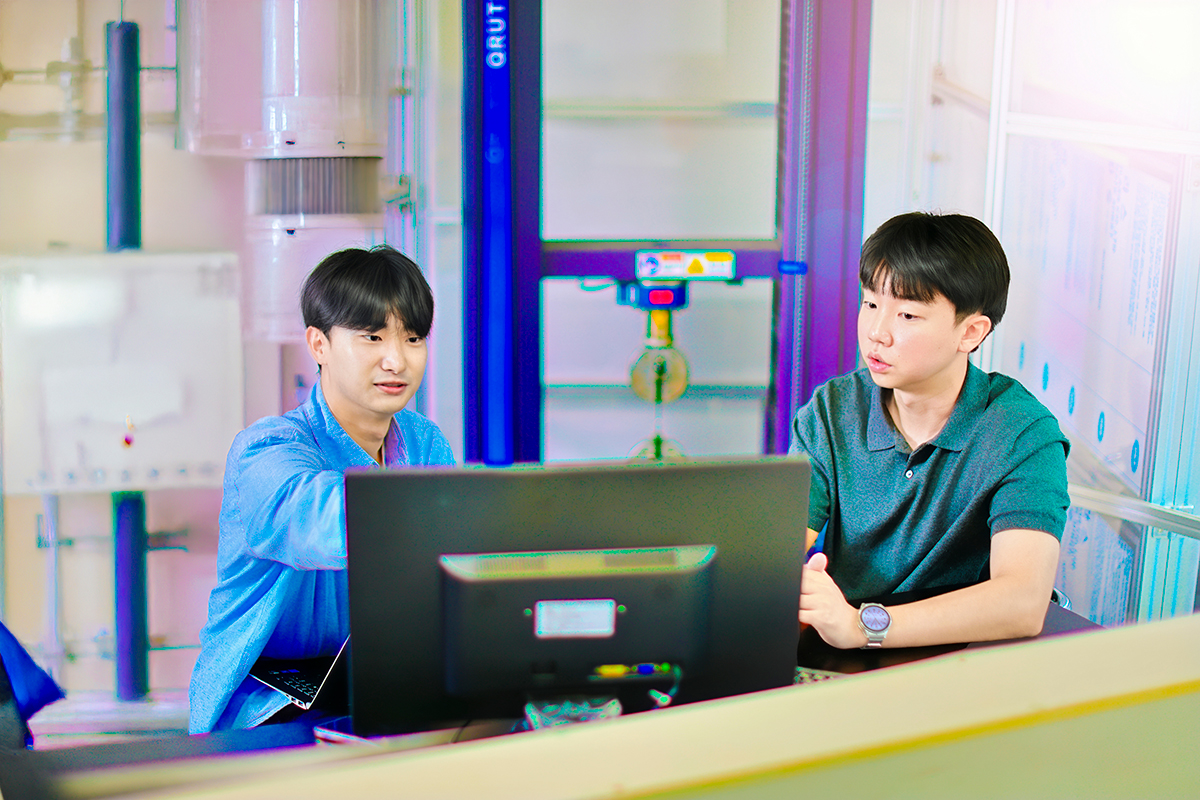
Two graduate students from Kyung Hee’s Department of Nuclear Engineering have recently earned international recognition for their outstanding research. Student Min Seek Kim won first place in the Bachelor’s and Master’s category of the American Society of Mechanical Engineers (ASME) Pressure Vessels & Piping (PVP) Division, while Student Do Yeon Lee received a graduate scholarship award at Structural Mechanics in Reactor Technology (SMiRT)
Both students are in the fourth semester of the master’s program and conduct their research in Professor Yoon Suk Chang’s laboratory in the Department of Nuclear Engineering. Student Min Seek Kim presented a study titled “Numerical Analyses for Derivation of New Control Rod Replacement Criteria,” which examines the structural integrity of reactor control rods. As nuclear power plants operate more flexibly and at higher output, control rods undergo repeated insertion and withdrawal, increasing the risk of wear and structural degradation. His work addresses this problem by proposing safer, data-driven replacement criteria for worn control rods.
Flexible operation and advanced reactor development
In this study, Student Kim performed a series of numerical simulations on representative wear defects observed in the control rods of standard Korean nuclear power plants. By varying parameters such as defect type, length, depth, and contact angle (wrapping angle), the analysis quantified how each geometric parameter affects integrity. “Based on the finite element results, I proposed replacement thresholds for each defect type and geometry,” he said. “These findings can support safe reactor operation and long-term control-rod life management.”
Student Do Yeon Lee presented a study titled “Creep Crack Growth Evaluation of SFR Pipe Using an Extended Damage Mode,” which addresses material reliability in fourth-generation nuclear reactors. In these next-generation systems, typical operating temperatures fall within the creep-sensitive range, meaning that structural components can gradually deteriorate due to creep crack growth. A reliable method for evaluating this behavior is therefore critical for safety.
Student Lee incorporated creep effects into the Gurson-Tvergaard-Needleman (GTN) fracture model to develop and validate an extended damage model. Focusing on piping in a Sodium-cooled Fast Reactor (SFR), Lee analyzed how initial crack geometry influences creep crack growth and quantified the time required to reach allowable crack lengths suggested in prior studies. “These results can serve as baseline data for structural reliability in nuclear power systems and help establish inspection criteria for crack evaluation in reactor piping,” he said.
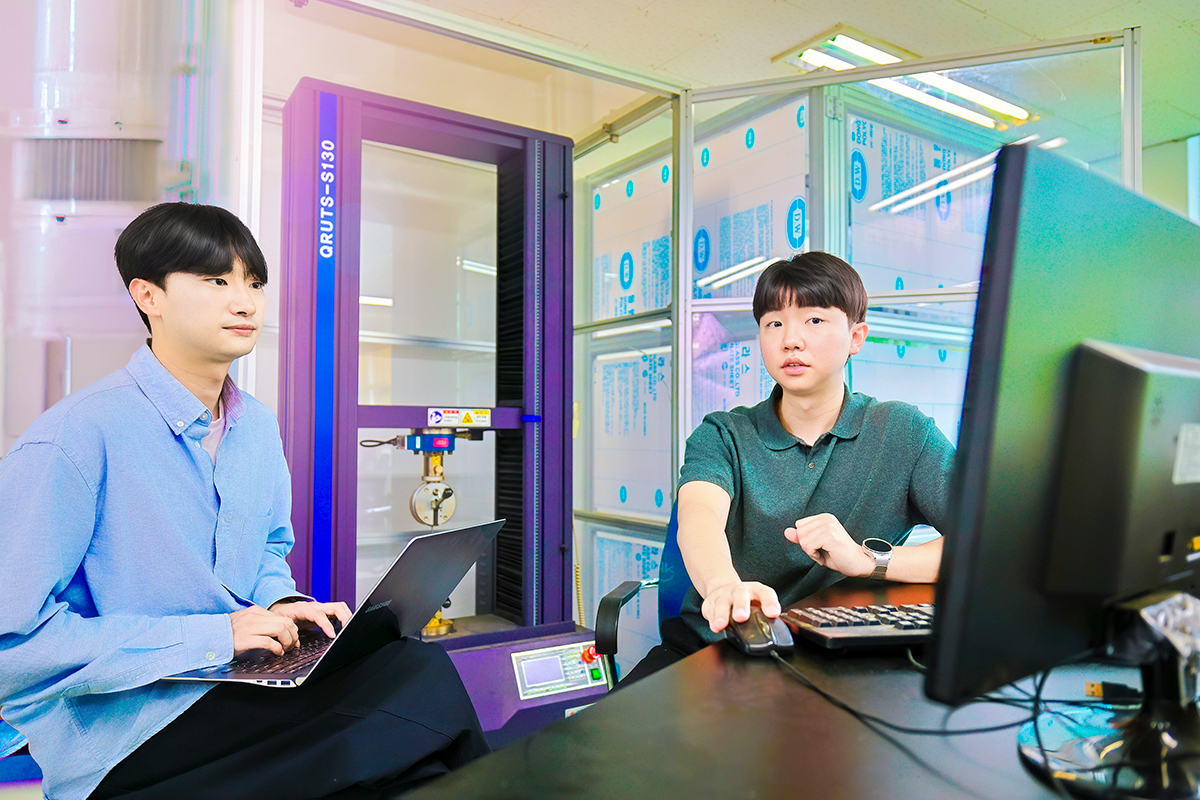
Kyung Hee Graduate Program trains experts in advanced reactor technology
The two students said that the strong research culture in their lab—including active encouragement to submit work to international conferences—helped them pursue ambitious projects early in graduate school. “In graduate school, I’ve learned what it means to take ownership of a research topic and drive it forward,” Student Lee said.
Both students gained early research experience as undergraduates at Kyung Hee and went on to pursue master’s degrees in the Department of Nuclear Engineering. The nuclear industry is entering a period of renewed innovation, from small modular reactors (SMRs) to Generation-IV reactor systems, and Kyung Hee students are already working in that space, not just reading about it in class. Professor Chang’s laboratory is directly involved in the design of Korean SMR systems, placing Kyung Hee’s Department of Nuclear Engineering firmly at the forefront of advanced reactor development.
-
Info
- University Communication & Press
- +82-2-961-0106
- khsd3080@khu.ac.kr