News
Kyung Hee Ranked 252nd Worldwide and 5th Among Comprehensive Universities in Korea by THE World University Rankings
2025-11-10 Research
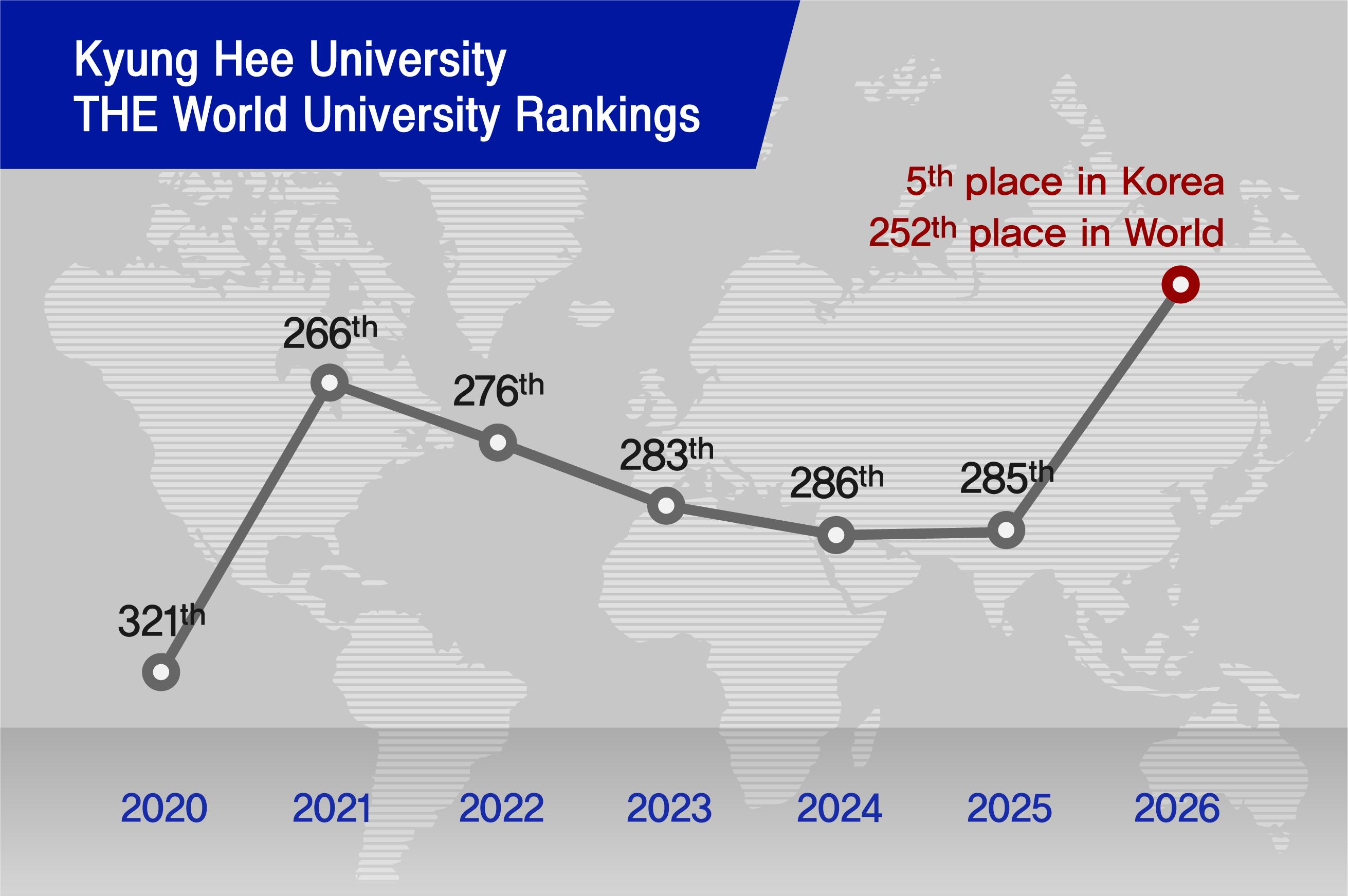
The University ranked 252nd globally and 5th among comprehensive universities in Korea in the 2026 THE World University Rankings announced by the British global evaluation agency Times Higher Education (THE)
The global ranking rose 33 places from the previous year, and the domestic ranking also climbed one spot, which now stands fifth. Kyung Hee demonstrated consistent growth across all categories. The rise was driven by outstanding research performance, reflecting Kyung Hee's commitment to becoming a "true university of future," one that contributes to society through both academic excellence and public value.
Steady growth across all categories: quality and quantity in tandem.
Among the performance indicators, the improvement in Research Quality, which reflects the qualitative level of research, showed marked improvement. Field-Weighted Citation Impact (FWCI), a key global index of research influence that includes FWCI average, FWCI at the top 25 percent, number of papers in the top 10 percent of cited papers, and Research Impact. FWCI measures how many times Kyung Hee's papers have been cited compared to the global average. The average FWCI of the University rose from 1.37 in 2019 to 1.42 in 2024, meaning Kyung Hee's papers have been cited 42% more often than the world average. Within the top 25 percent of cited papers, the figure climbed even higher, rising from 1.36 in 2019 to 1.54 in 2024, placing the University third in Korea.
Kyung Hee's research output has improved in both quality and quantity. The number of academic articles included in THE’s evaluation steadily grew from 16,023 in 2019 to 20,934 in 2024. The number of papers ranked in the top 10 percent for Citations impact also climbed, ranking the University third among domestic universities. Along with the increase in the number of papers ranked in the top 10 percent, the proportion of these papers also increased from 11.5% in 2019 to 14.2% in 2024.
World-class achievements in diverse fields, including medicine and health sciences, engineering, applied sciences, natural sciences, and basic sciences.
The number of international collaborative research projects also grew, placing the University third among domestic universities. Along with the quantitative increase, the proportion of international collaborative research projects rose from 29.8% in 2019 to 38.1% in 2024. By field, notable achievements were recorded in medicine & health sciences, engineering & applied sciences, and natural sciences & basic sciences. Within medicine, research focused on global disease epidemiology, digital health, oncology, and geriatrics, with the relevant teams achieving world-class FWCI scores
Engineering and applied science fields, which underpin the development of cutting-edge technologies and future industrial advancement, also received strong recognition. Researchers in materials innovations such as next-generation semiconductors, optoelectronic devices, environmental monitoring, and next-generation displays, precision mechanical systems, and robot control are making significant strides. Equally noteworthy is the excellence in basic science, which forms the foundation for applications. High citation counts attest to Kyung Hee researchers’ advances in the understanding of life’s fundamental mechanisms through high-impact work in biology, environment, and ecology. Together, these efforts constitute the backbone of a research ecosystem that supports innovation from principle to application.
Internationalization, the main focus since the University's founding, has driven international collaborative research.
International joint research has emerged as a decisive factor in the improvement in Kyung Hee’s research quality. Between 2019 and 2024, the proportion of internationally co-authored papers steadily increased, achieving an average FWCI of 2.63.
The International Center for Quantum Matter, which opened last year, exemplifies Kyung Hee’s commitment to global research excellence. Established following Professor Seok-Kyun Son’s selection for the Ministry of Science and ICT's Limit Challenge R&D Project, the Center brings together global quantum experts including Professors Konstantin Novoselov ES (National University of Singapore), winner of the 2010 Nobel Prize in Physics, and Phillip Kim ES (Harvard University), working alongside Kyung Hee researchers from the Departments of Physics, Mathematics, Chemistry, and Applied Physics.
Internationalization has long been a cornerstone of Kyung Hee’s academic identity. This year, the University ranked second in Korea for global engagement: a testament to a founding philosophy that has, over the history of Kyung Hee, become its defining ethos. This academic ethos of international cooperation has been a decisive factor in strengthening this year's evaluation, reflected in markedly improved scores for global collaborative research.
Professor Dong Keon Yeon of the Department of Medicine and the Center for Digital Health have consistently delivered world-class research results through international collaborative research, publishing 286 SCI papers over the past two years. Kyung Hee is engaged in joint research with leading global teams, including the Institute for Health Metrics and Evaluation (IHME) at the University of Washington, the Gates Foundation, and Harvard Medical School. In June, Kyung Hee was selected for the 2025 Medical AI Specialized Convergence Talent Development Project (Director: Professor Tong In Oh, College of Medicine), hosted by the Ministry of Health and Welfare. With a five-year budget of 4.75 billion KRW, this initiative will cultivate globally competitive talent at the intersection of artificial intelligence and medicine.
Overcoming challenges, growing into a "true university of future"
Kyung Hee now turns its attention to consolidating this momentum into sustainable growth. While the University firmly occupies a top-tier position in Korea, a quantum leap is needed to close the gap with the global elite. To achieve this, Kyung Hee is driving innovation across all areas, including status, personnel, finances, infrastructure, and satisfaction. The next three to four years have been designated as a pivotal “golden time” for university transformation, with strengthened policy and planning functions aimed at elevating the University’s global standing.
Kyung Hee will enhance its research support system to empower faculty to pursue excellence in research. To lead higher education in the era of AI Transition (AX), the University is also building a robust AI-based infrastructure. The Kyung Hee AI Committee is set to oversee the deployment and governance of artificial intelligence across all areas of the University, while the newly established Institute Research (IR) Center will provide data-driven insights to inform objective, strategic decision-making. Through these initiatives, Kyung Hee aims to solidify its identity as a "true university of future" by strengthening its core values of education and research, while continuing its efforts to build systems, culture, and practices that inspire pride and aspirations among its members.
-
Info
- University Communication & Press
- +82-2-961-0106
- khsd3080@khu.ac.kr