Professor Sung Hun Jin at the Department of Information Display has built a research career around a simple but ambitious premise: everyday curiosity, when pursued seriously, can yield technologies capable of solving problems in medicine, security, and sustainability
His recent work spans an unusual range—biodegradable batteries made from spent coffee grounds, memory devices that physically dissolve to erase data, and needle-sized sensors designed to diagnose medical emergencies in real time. In the interview below, Professor Jin discusses his recent research and the thinking behind how he develops new ideas. <Editor's Note>
A multimodal sensor for a silent medical emergency
Q. Much of your work seems to revolve around what you call “solving problems through material integration.” How did that idea take shape, and how does it guide your research today?
A. I became interested not only in developing new materials, but in finding better ways to integrate materials and platforms that already exist. For me, materials are not an end in themselves—they are tools for achieving a research goal. That way of thinking is reflected in the name of our lab, HIGH, which stands for Hybrid Integration for Genuine Hyper-functionality. In practice, this means bringing together core technologies from different fields, such as displays, memory devices, biomedical sensing, and security. By combining these areas, rather than treating them in isolation, we try to address complex problems that society is facing—whether it’s climate change or growing vulnerabilities in information security.
Q. One of your recent papers addresses acute compartment syndrome using an ultrathin multimodal sensor. What problem were you trying to solve, and what makes this approach different from existing diagnostic methods?
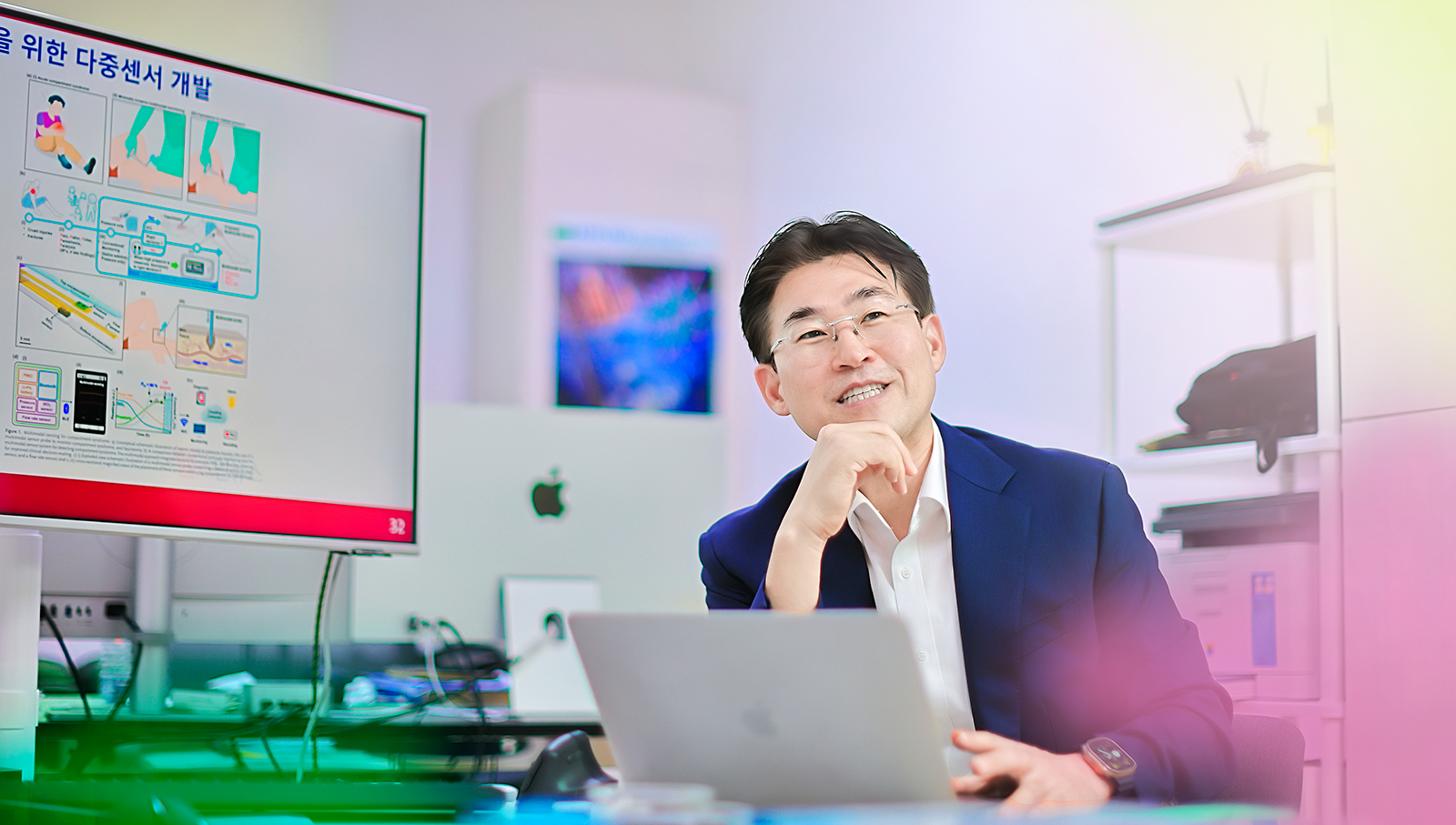
A. Acute compartment syndrome is a medical emergency in which pressure builds rapidly within a muscle compartment, restricting blood flow to the surrounding tissues. If it is not diagnosed and treated within 24 hours, it can result in paralysis or, in severe cases, amputation. The challenge is that current diagnostic methods rely heavily on a physician’s experience and judgment, or on intermittent pressure measurements taken with a needle. Those approaches capture only a snapshot in time and often fail to reflect the wide variability in a patient’s condition. As a result, misdiagnosis or delayed treatment can occur.
To address this limitation, we developed a multimodal sensor probe that can simultaneously measure compartment pressure, tissue oxygen saturation (StO₂), and blood flow from the same location, in real time. The probe is extremely small—about 4 millimeters in diameter and 1 millimeter thick—and is made from biocompatible materials. Once inserted, it continuously collects all three physiological signals and transmits the data wirelessly via Bluetooth Low Energy to an external device. Because the data are streamed in real time, they can be used for AI-assisted analysis. This does not replace clinical judgment, but it provides clinicians with more comprehensive and objective information, helping to improve diagnostic accuracy.
To address this limitation, we developed a multimodal sensor probe that can simultaneously measure compartment pressure, tissue oxygen saturation (StO₂), and blood flow from the same location, in real time. The probe is extremely small—about 4 millimeters in diameter and 1 millimeter thick—and is made from biocompatible materials. Once inserted, it continuously collects all three physiological signals and transmits the data wirelessly via Bluetooth Low Energy to an external device. Because the data are streamed in real time, they can be used for AI-assisted analysis. This does not replace clinical judgment, but it provides clinicians with more comprehensive and objective information, helping to improve diagnostic accuracy.
When memory is meant to vanish
Q. Your second line of research focuses on what you call self-dissolving memory. What is the core idea behind this technology?
A. The core concept is what we refer to as transient electronics—technology that is designed to physically disappear once its role is complete. In this case, we developed a resistive switching memory based on cesium iodide that can dissolve under specific environmental conditions. This work grew out of a fundamental question about data security: how do you ensure that information cannot be recovered at all?
Even when data are electrically erased from conventional memory devices, physical traces often remain, making it possible to reconstruct information using recovery software or hacking techniques. Our approach takes a fundamentally different path. When exposed to humidity or direct contact with water, the memory device itself dissolves completely, destroying the stored information rather than merely deleting it. Importantly, the device leaves no residue as it dissolves. At the same time, it maintains strong operational performance, including high responsiveness and durability, while remaining environmentally friendly and scalable across a wide range of applications.
It has clear potential in high-risk and high-security environments. Examples include military equipment that cannot be retrieved after deployment, disposable medical diagnostic sensors, financial authentication systems, and temporary electronic devices used in space exploration. Looking further ahead, it could even address hypothetical scenarios such as brain hacking. If an implanted device were compromised, the information could be eliminated by dissolving the device itself. In that sense, it offers a very powerful platform for information protection.
Even when data are electrically erased from conventional memory devices, physical traces often remain, making it possible to reconstruct information using recovery software or hacking techniques. Our approach takes a fundamentally different path. When exposed to humidity or direct contact with water, the memory device itself dissolves completely, destroying the stored information rather than merely deleting it. Importantly, the device leaves no residue as it dissolves. At the same time, it maintains strong operational performance, including high responsiveness and durability, while remaining environmentally friendly and scalable across a wide range of applications.
It has clear potential in high-risk and high-security environments. Examples include military equipment that cannot be retrieved after deployment, disposable medical diagnostic sensors, financial authentication systems, and temporary electronic devices used in space exploration. Looking further ahead, it could even address hypothetical scenarios such as brain hacking. If an implanted device were compromised, the information could be eliminated by dissolving the device itself. In that sense, it offers a very powerful platform for information protection.
Power from waste: a new biodegradable battery
Q. Your biodegradable battery made from spent coffee grounds drew a great deal of public attention. How did that idea originate?
A. The starting point was a very simple observation: an enormous amount of coffee waste is generated every day. We began asking whether there was a way to repurpose that waste in a form that would minimize environmental impact rather than add to it. That led to the idea of using spent coffee grounds as a structural frame for biodegradable batteries. We process the coffee grounds into a porous frame material and combine it with a magnesium alloy (AZ31) anode and a molybdenum trioxide (MoO₃) cathode. This configuration allows the battery to maintain practical energy density while remaining fully biodegradable, degrading naturally within about 60 days. The frame is not limited to holding electrodes. It is designed as a platform structure that allows easy integration with sensors, circuits, and other electronic components.
One clear application is environmental monitoring in locations where collecting devices afterward is difficult or impossible. For example, sensors mounted on microfliers could be used to monitor air quality indicators such as ozone or nitrogen dioxide, or to track wildfire risk. Once the monitoring period ends, the system naturally decomposes. That makes it possible to build monitoring networks without generating electronic waste, which is increasingly important from a sustainability perspective.
One clear application is environmental monitoring in locations where collecting devices afterward is difficult or impossible. For example, sensors mounted on microfliers could be used to monitor air quality indicators such as ozone or nitrogen dioxide, or to track wildfire risk. Once the monitoring period ends, the system naturally decomposes. That makes it possible to build monitoring networks without generating electronic waste, which is increasingly important from a sustainability perspective.
Toward integrated, disappearing systems
Q. Looking ahead, what is your roadmap for integrating these technologies, both in the near term and over the longer horizon?
A. In the near term, our focus is on expanding the clinical applications of the sensing platform we have developed. The global market for diagnosing acute compartment syndrome is relatively small—valued at approximately 300 billion KRW (about 204 million USD) worldwide—which limits its broader impact. To address this, we plan to extend the same pressure-sensing platform to the diagnosis of hydrocephalus, a condition in which continuous pressure monitoring is essential. The global market for hydrocephalus diagnostics is significantly larger, estimated at around ten trillion KRW (about 6.8 billion USD). As a next step, we are developing a miniaturized platform designed to be implanted in the brain to directly measure intracranial pressure.
Over the longer term, the goal is to integrate the technologies we have developed into unified systems. For example, a biodegradable battery could serve as the power source, while transient sensors collect data and self-dissolving memory devices protect sensitive information. By bringing these elements together, we aim to build integrated platforms for smart healthcare and environmentally responsible electronics.
Over the longer term, the goal is to integrate the technologies we have developed into unified systems. For example, a biodegradable battery could serve as the power source, while transient sensors collect data and self-dissolving memory devices protect sensitive information. By bringing these elements together, we aim to build integrated platforms for smart healthcare and environmentally responsible electronics.