Connector Technology Development and Successful Demonstration of Data Transmission & Reception
2025.10.01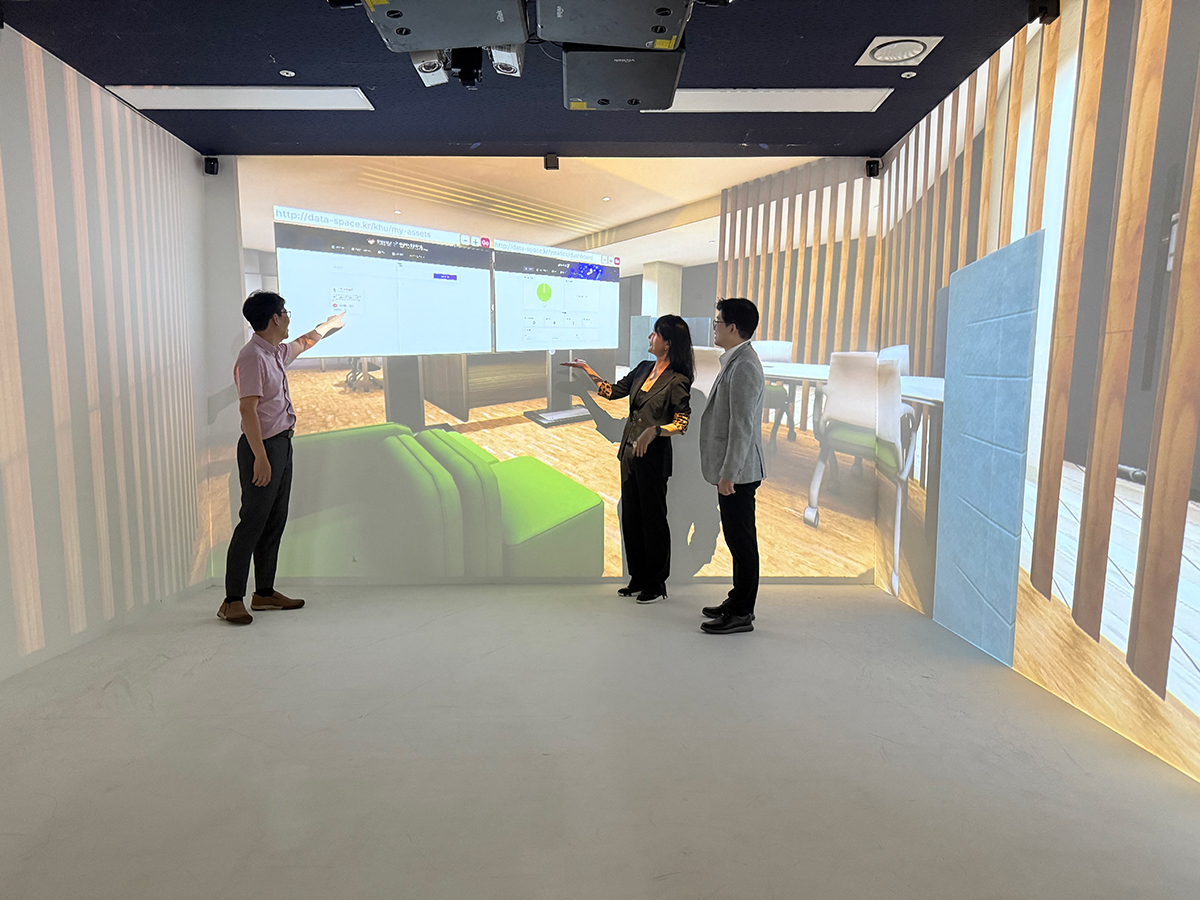
A research team from the Department of Metaverse of the Graduate School has successfully demonstrated Korea’s first metaverse based data space
Led by Professors Sangmin-Michelle Lee, Seokhee Jeon, and Tack Woo, the research team collaborated with the Korean company Y-Matics Inc. to jointly develop connector technology that enables data transmission, reception, and settlement within the metaverse, a breakthrough that has attracted significant attention. The experiment was conducted in a metaverse-style replica of Woojungwon, the university building that houses the department. Through the newly developed connector, the team successfully visualized the process of transmitting 3D spatial data and user behavior logs generated by movements within the metaverse Woojungwon. During the demonstration, Y-Matics’s domestically developed data space connector enabled not only simple data exchange but also settlement functionality. Users can directly access desired data through a data space catalog and process usage settlement by data type through a clearinghouse, establishing a technical foundation for future data transactions.
Expanding data spaces for educational innovation
The team is extending these findings to education. Professor Lee is currently developing a sandbox-style XR teaching and learning space, a virtual learning environment where students can freely express their creativity and complete projects. Equipped with AI agents, the system provides personalized learning support tailored to each student's needs. By linking this space to a data space, the team can collect and analyze student behavioral data in real time, providing an evaluative basis for scientifically validating educational effectiveness. Professor Lee emphasized, "An XR learning space equipped with AI agents can enhance learners' creativity and collaboration skills. Integrating it with a data space will mark a turning point in strengthening its reliability and effectiveness in educational settings."Professor Lee's lab (2xAI Lab) is also developing and piloting a foreign language education AI system based on the Diffusion Model. The lab plans to integrate this system with a data space to enhance personalized learning support and continue research on the secondary use of learning data.
Expanding to hyper-realistic metaverse and physical AI
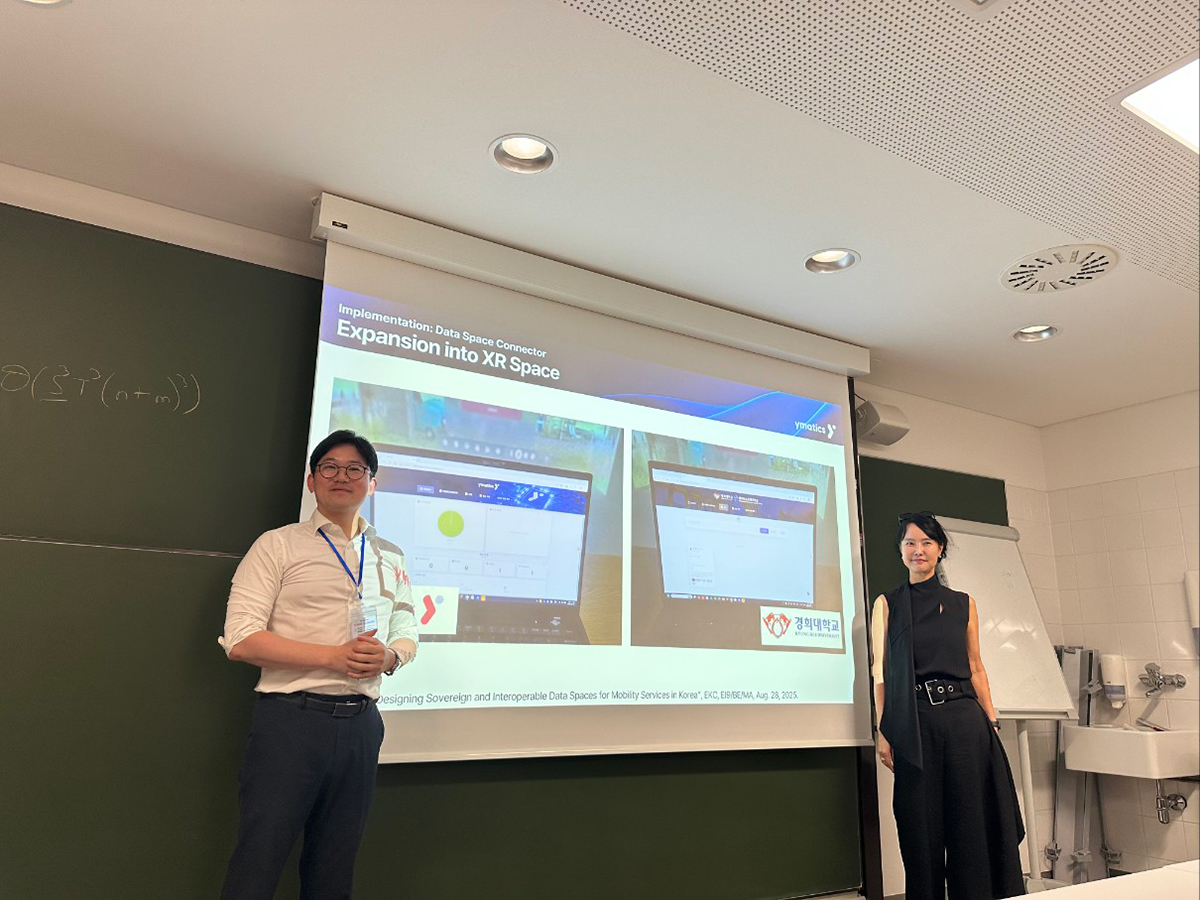
Professors Jeon and Woo are leading contents research that combines physical interaction and gamification elements within the metaverse, supported by the National Research Foundation of Korea and the Institute of Information & Communications Technology Planning and Evaluation (IITP). Their project aims to build a multimodal data space capable of processing not only visible 3D screen information but also human movement, behavior, and physical response data. This research contributes to the creation of an immersive, hyper-realistic metaverse and shows strong potential for connection with emerging Physical AI technologies, which integrate real-world sensory and behavioral data into intelligent systems. Data spaces will thus serve as a new bridge, transcending mere virtual environments and connecting human behavior and artificial intelligence.Through the Triple Helix mode of innovation, Kyung Hee has been advancing the integration of data space technology into the metaverse. This achievement, presented at the EKC 2025 academic conference in Vienna, Austria, garnered international attention. By demonstrating successful data transmission, reception, and settlement, the University has secured both data sovereignty and interoperability, presenting a new technological direction that bridges the real and the virtual worlds.
- SDG 4 - Quality Education
- SDG 9 - Industry, Innovation and Infrastructure
- SDG 11 - Sustainable Cities and Communities
- SDG 17 - partnerships for the goals
- ⓒ경희대학교 커뮤니케이션센터 communication@khu.ac.kr